


OMIM ID:
Gillespie Syndrome
Alternate Names
Defective Genes
Clinical Characteristics
Ocular Features
Bilateral aniridia, partial or complete, is the ocular characteristic of Gillespie syndrome. The iris may be relatively intact but immobile leading to the description in some patients of “dilated and fixed pupils”, or congenital mydriasis. The pupillary margin may be scalloped with iris strands to the lens. The pupillary sphincter is sometimes absent and the mesodermal surface missing. The fovea sometimes appears hypoplastic and some patients have decreased visual acuity. Strabismus and ptosis are often present. There may also be retinal hypopigmentation. Cataract, glaucoma, and corneal opacities are not present.
Systemic Features
Most patients have some degree of developmental delay ranging from difficulties with fine motor tasks to frank mental retardation. Many have a hand tremor, some degree of hypotonia, and learning difficulties. MRI imaging often shows cerebellar and sometimes cerebral hypoplasia.
Genetics
Inheritance
This is an autosomal dominant disorder usually due to a heterozygous mutation in the PAX6 gene (11p13). However, some patients with typical features do not have a mutation in this gene suggesting that there is genetic heterogeneity. Some patients without point mutations nevertheless have defects in adjacent DNA suggesting a positional effect. The possibility of autosomal recessive inheritance in some families with parental consanguinity cannot be ruled out. The PAX6 gene plays an important role in iris development as it is also mutant in simple aniridia (106210) and in Peters anomaly (604229).
Mutations in the ITPR1 gene have also been identified in Gillespie syndrome.
Pedigree
Autosomal dominant
Autosomal dominant disorders require only one mutation for the disease to be expressed. Since an affected parent has two chromosomes, only one of which has the mutant gene, parents can expect that half (50%) of their children will receive that one and inherit the disease. It is common for individuals that inherit the mutation, however, to not have evidence of the disease (nonpenetrance).
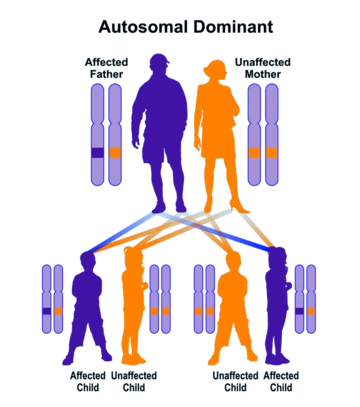
Autosomal dominant inheritance leads to a vertical pattern of transmission